
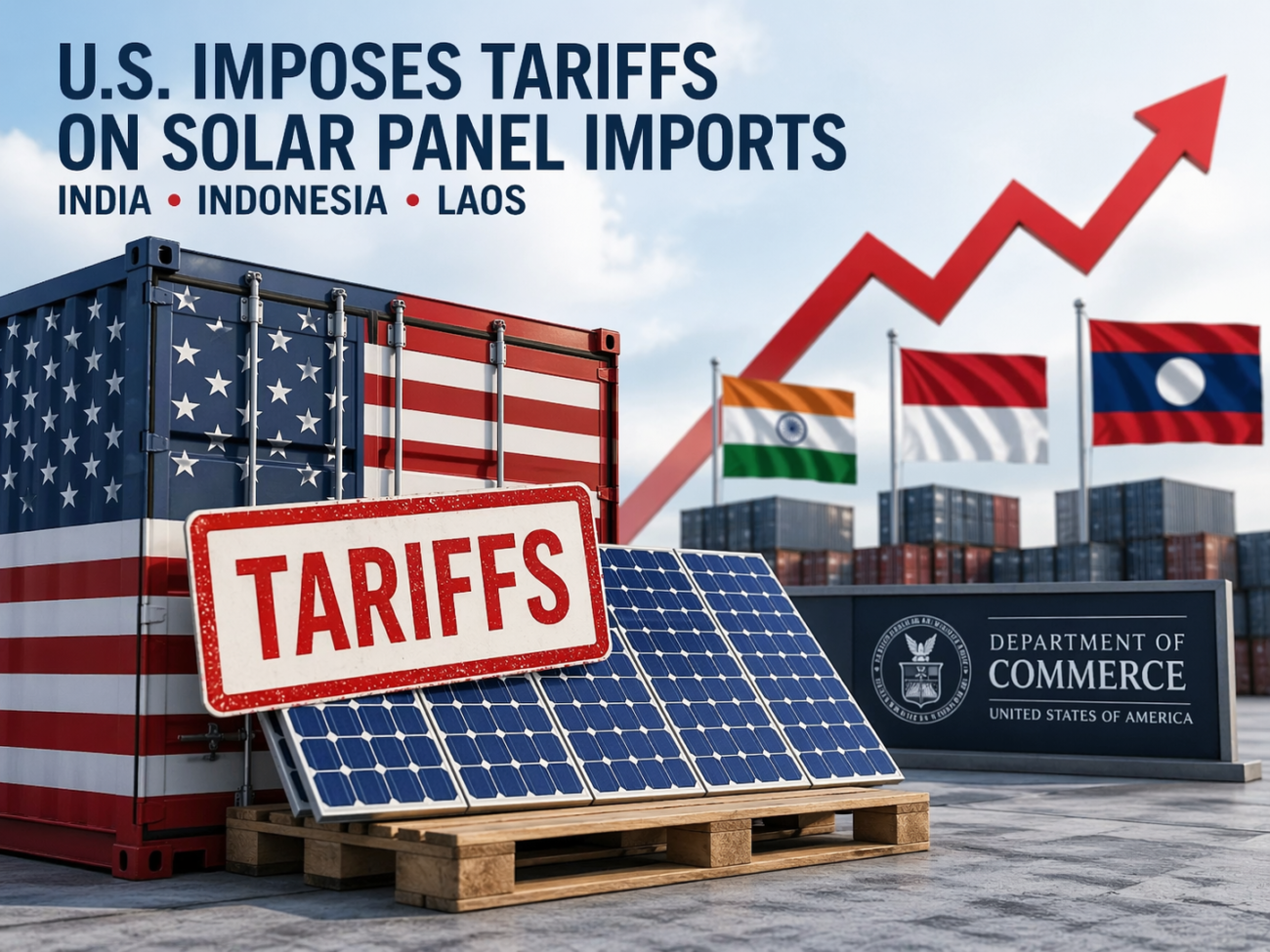
The United States Department of Commerce has announced preliminary anti-dumping duties on solar cells and panels imported from several Asian countries. The measures target shipments from India, Indonesia, and Laos — a move that could significantly reshape the market landscape.
Reason: Protecting Domestic Manufacturers
U.S. regulators concluded that manufacturers from these countries were supplying solar products at artificially low prices, creating unfair competition for American producers.
As a result, preliminary tariffs have been set at:
- India — 123.04%
- Indonesia — 35.17%
- Laos — 22.46%
While these measures are not yet final, they already signal a strong shift in U.S. trade policy.
Market Impact and Scale
According to official trade data, imports of solar panels from these three countries reached approximately $4.5 billion last year, accounting for a significant share of total U.S. demand.
In practical terms:
- these countries supply around two-thirds of U.S. solar panel imports
- they play a critical role in supporting the fast-growing renewable energy sector
The new tariffs could lead to:
- higher installation costs
- reduced import volumes
- stronger positioning for domestic manufacturers
Who Initiated the Case
The investigation was triggered by a coalition of U.S. solar manufacturers, including:
- First Solar
- Qcells
- Talon PV
- Mission Solar
Their petition led to the official review and the introduction of these duties.
What Happens Next
This decision is only a preliminary step. A final ruling on anti-dumping tariffs is expected later, which will determine long-term trade conditions.
However, it is already clear that:
- the U.S. is strengthening its protectionist policies
- pressure on Asian exporters is increasing
- the solar energy market may undergo structural changes
Conclusion
The introduction of tariffs is not just a regulatory move — it reflects a broader global competition in technology and energy sectors.
For investors and market participants, this means:
- closely monitoring policy changes
- anticipating price increases
- adapting strategies to new market conditions
These developments will impact not only the solar industry but also the broader financial and energy markets.